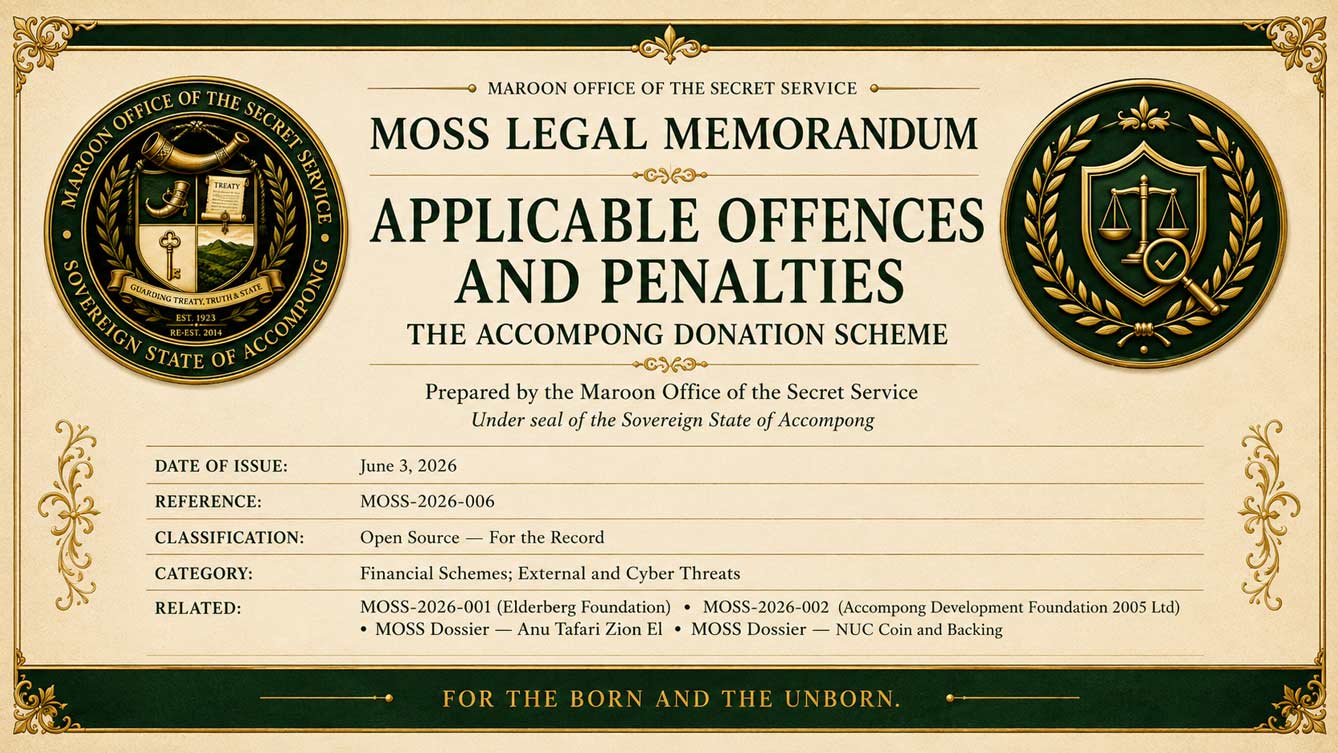
Subject: Applicable Offences and Penalties — The Accompong Donation Scheme
Prepared by the Maroon Office of the Secret Service Under seal of the Sovereign State of Accompong Classification: Open Source — For the Record Category: Financial Schemes; External and Cyber Threats Related: MOSS-2026-001 (Elderberg Foundation); MOSS-2026-002 (Accompong Development Foundation 2005 Ltd); MOSS Dossier — Anu Tafari Zion El; MOSS Dossier — NUC Coin and Backing
1. Purpose and limits of this memorandum
This memorandum sets out the categories of law that may apply to the public-donation activity conducted under the banner of the Sovereign State of Accompong, and the penalties those laws carry. A federal complaint has been filed with the United States Federal Bureau of Investigation through its Internet Crime Complaint Center (IC3), naming the relevant subjects and entities; this Office holds the submission record.
This Office does not pronounce guilt. Whether any offence has been committed is for the competent authorities — the FBI, the United States Department of Justice, the Internal Revenue Service, the Florida Department of Agriculture and Consumer Services, and any Jamaican authority of competent jurisdiction — to determine. This memorandum identifies the law that governs the conduct described in MOSS-2026-001 and MOSS-2026-002, and states the maximum penalties on the public record so that donors and the public understand what is at stake.
2. The conduct, in brief
As documented in the prior advisories and the federal complaint:
- Public donations are solicited under the name of the Sovereign State of Accompong, a real Jamaican Maroon community, through GoFundMe and other appeals.
- Funds pass through the Elderberg Foundation (Sanford, Florida), an entity with no verified IRS 501(c)(3) status and no verified registration under Florida’s charitable-solicitation law.
- Funds are then transferred onward to Accompong Development Foundation 2005 Ltd, a Jamaican private limited company, and to a personal CashApp account.
- The two senior officers of Elderberg, Anu Tafari Zion El and Dawud Allantu Bey, were defendants who lost a United States federal land matter in 2021.
- No verified charitable accountability is evidenced at any stage.
The amounts publicly confirmed exceed US$326,000 (GoFundMe campaigns plus a US$200,000 stage presentation), with the Elderberg website’s own counter acknowledging donations received.
3. United States federal law
3.1 Wire fraud — 18 U.S.C. § 1343
Wire fraud is the use of interstate or international wire communications (internet, email, electronic payment, telephone) to carry out a scheme to obtain money by false or fraudulent representations. Online donation appeals that cross state or national borders fall squarely within the wire it describes.
- Maximum penalty: up to 20 years in federal prison per count, plus a fine of up to $250,000 for an individual.
- Each communication is a separate count. Every email, post, or electronic transfer in furtherance of a scheme can be charged separately, so exposure compounds rapidly.
- Enhanced penalty: where the offence affects a financial institution, or relates to a presidentially-declared major disaster or emergency, the maximum rises to 30 years and a fine up to $1,000,000. (This enhancement is the same one engaged where relief programs are abused — relevant to the network, given that a figure central to the asset backing of the associated NUC matter was federally convicted under the disaster-relief enhancement.)
3.2 Mail fraud — 18 U.S.C. § 1341
Where any solicitation, acknowledgement, or instrument is sent through the US mail or a private carrier in furtherance of the scheme, mail fraud applies. It carries the same penalty structure as wire fraud — up to 20 years per count (up to 30 years with the financial-institution or disaster enhancement). Mail and wire fraud are routinely charged together.
3.3 Money laundering — 18 U.S.C. §§ 1956–1957
Moving the proceeds of an unlawful scheme through accounts and entities — for instance, routing donations through a US foundation and then on to a foreign company and a personal account — can engage the money-laundering statutes where the transfers are designed to conceal the source, nature, or control of the funds.
- Section 1956 (laundering of monetary instruments): up to 20 years per count, and a fine up to the greater of $500,000 or twice the value of the property.
- Section 1957 (transactions in criminally derived property over $10,000): up to 10 years per count.
3.4 Identity / false-instrument exposure — 18 U.S.C. §§ 1028, 1028A
The IC3 complaint form itself is authorized under, among others, 18 U.S.C. § 1028 (production or use of false identification documents) and § 1028A (aggravated identity theft). Where authority, office, or identity is asserted through fabricated or color-of-law instruments, these provisions may be engaged. Section 1028A carries a mandatory consecutive 2-year term where aggravated identity theft is proven.
4. Florida state law
4.1 Florida Solicitation of Contributions Act — Chapter 496, Florida Statutes
Florida requires any charitable organization soliciting contributions in or from Florida to register with the Florida Department of Agriculture and Consumer Services (FDACS) before soliciting, and to renew annually (§§ 496.405, 496.406). An organization that has reached US$50,000 in revenue must register within 30 days.
- Failure to register while soliciting is a third-degree felony, punishable by up to 5 years in Florida state prison, plus fines.
- Falsely claiming affiliation with another organization, or false representation of a charity’s mission (§ 496.415), and filing false information with FDACS, are separately actionable and can carry criminal liability.
A Sanford, Florida entity soliciting donations with no verified FDACS registration, while a website counter acknowledges donations received, is precisely the conduct this chapter is written to reach.
4.2 Misrepresentation of charitable status
Soliciting as though donations are tax-deductible or charitable, where no IRS 501(c)(3) determination exists, exposes the solicitor to both the Florida provisions above and federal false-representation theories, and exposes donors to disallowed deductions.
5. Jamaican dimension
Where funds solicited abroad are routed to a Jamaican private limited company presented to the public as a sovereign or charitable instrument of the Maroons, Jamaican law on fraud, false accounting, and the conduct of companies may be engaged, and the matter falls within the interest of Jamaican authorities. As Chief Currie himself acknowledged in his public address, the relevant accounts sit within Jamaican jurisdiction, and findings have been referred to the Jamaica Constabulary Force and the Major Organised Crime and Anti-Corruption Agency (MOCA). This Office records that dimension and defers to those authorities.
6. Summary of exposure
| Law | Conduct reached | Maximum penalty |
|---|---|---|
| 18 U.S.C. § 1343 (wire fraud) | Online/electronic donation appeals to obtain money by misrepresentation | 20 yrs/count; 30 yrs if disaster/financial-institution enhancement; up to $1M fine |
| 18 U.S.C. § 1341 (mail fraud) | Mailed solicitations/instruments in furtherance | 20 yrs/count (30 yrs enhanced) |
| 18 U.S.C. §§ 1956–1957 (money laundering) | Routing proceeds through entities/accounts to conceal | 20 yrs (§1956); 10 yrs (§1957) per count |
| 18 U.S.C. §§ 1028 / 1028A | False instruments / asserted identity or authority | up to 15 yrs; +2 yrs mandatory consecutive (1028A) |
| Florida Ch. 496 | Soliciting without FDACS registration; false charitable representation | 3rd-degree felony — up to 5 yrs + fines |
7. Position of the Office
The Maroon Office of the Secret Service:
- Identifies the foregoing bodies of law as those governing the donation activity conducted under the banner of the Sovereign State of Accompong, as documented in MOSS-2026-001 and MOSS-2026-002.
- Records that a complaint has been filed with the United States FBI through its Internet Crime Complaint Center, and separately reported to FBI Jacksonville, the Florida Department of Agriculture and Consumer Services, and the Internal Revenue Service exempt-organizations division.
- Makes no finding of guilt. The determination of whether any offence has been committed rests with the competent United States, Florida, and Jamaican authorities.
- Advises the public and prospective donors that contributions solicited under the Maroon name through the entities described cannot be confirmed by this Office as lawfully registered, charitable, tax-deductible, or accountable, and that the legal exposure set out above attaches to such schemes.
8. Sources
- United States Code: 18 U.S.C. §§ 1341, 1343, 1956, 1957, 1028, 1028A (Legal Information Institute / Cornell).
- US Department of Justice and federal sentencing references on wire-fraud penalties and the disaster/financial-institution enhancement (30-year maximum).
- Florida Statutes Chapter 496 (Solicitation of Contributions Act), §§ 496.405, 496.406, 496.415, 496.417; FDACS registration requirement; third-degree-felony penalty.
- Federal complaint filed via the FBI Internet Crime Complaint Center (IC3), April 2026 (submission record held by this Office); reports to FBI Jacksonville, FDACS, and IRS EO.
- Cross-reference: MOSS-2026-001; MOSS-2026-002; MOSS Dossier — Anu Tafari Zion El; MOSS Dossier — NUC Coin and Backing.
This memorandum is a statement of applicable law and maximum penalties on the public record. It is not legal advice and not a finding of guilt. Determinations of criminal liability rest solely with the competent authorities.
Keepers of the records. For the Born and the Unborn.